
Disclosure: This post may contain affiliate links. As an Amazon Associate, I earn from qualifying purchases.
Why Multi-Country Trips Feel Complicated at First
Planning a trip to one destination is straightforward. Add two or three countries, and suddenly everything feels more complex.
Flights, borders, transportation, timing, logistics. It can quickly become overwhelming.
But once you understand how to plan a multi country trip, it becomes one of the most rewarding ways to travel. You experience more variety, maximize long-haul flights, and build a trip that feels dynamic rather than repetitive.
Start With Geography, Not a Bucket List
The biggest mistake people make is choosing destinations based purely on interest without considering geography.
A smarter approach is to group countries that are close together or well-connected.
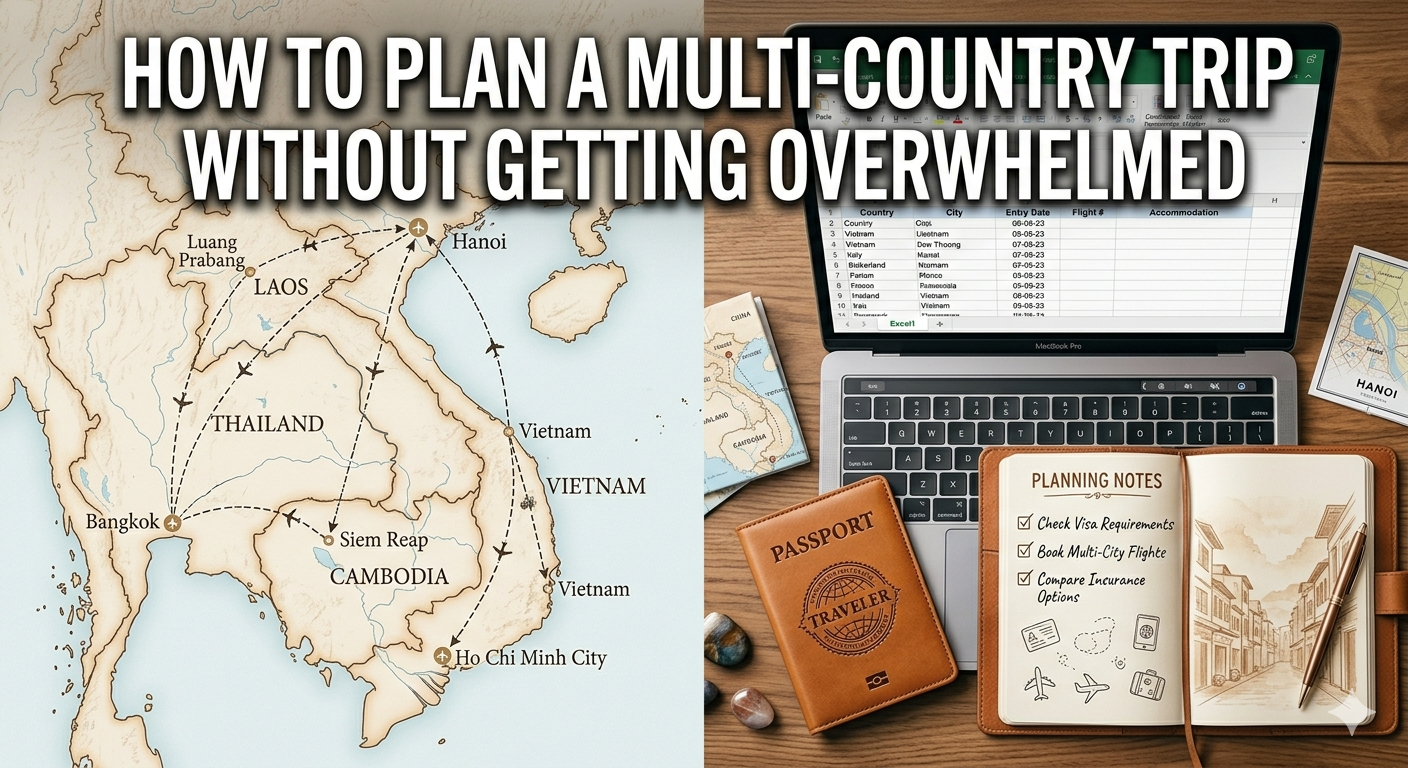
For example, Southeast Asia flows naturally between Thailand, Vietnam, and Cambodia. Western Europe can easily connect cities like Paris, Amsterdam, and Rome.
This reduces travel time, cost, and stress.
Build Around a Logical Route
Think in terms of direction.
Instead of bouncing back and forth across a region, create a forward-moving route. This could be north to south, east to west, or a circular loop.
Backtracking wastes time and money. A clean route keeps your trip efficient and easier to manage.
Choose the Right Number of Destinations
More is not always better.
For most trips, three to five destinations is the sweet spot. Anything beyond that often becomes rushed.
A good rule is to spend at least three full days in each major stop. Faster travel tends to blur together and reduces the quality of the experience.
Flights vs Trains vs Buses
Transportation choices matter more on multi-country trips.
Flights are best for long distances or crossing water. Budget airlines can be extremely cheap if booked early.
Trains work well in regions like Europe where rail networks are strong and city-center to city-center travel is efficient.
Buses are the most budget-friendly option but can take longer. They are common in regions like Southeast Asia and Central America.
Choosing the right mix keeps your trip both efficient and affordable.
Understand Entry Requirements Before You Go
Each country has its own visa rules, entry requirements, and documentation needs.
Some allow visa-free entry. Others require advance applications or visas on arrival.
Also pay attention to passport validity rules. Many countries require at least six months of validity beyond your travel dates.
This is one of those details that can completely derail a trip if ignored.
Pack for Versatility, Not Specific Moments
Multi-country trips often include different climates, cultures, and activities.
Instead of packing for each destination separately, build a flexible wardrobe that works across multiple environments.
Layering becomes essential. Lightweight pieces that can be mixed and matched will save space and simplify your travel.
Plan Key Logistics, Leave Room for Flexibility
Book your major flights and your first few accommodations in advance.
Beyond that, leave some flexibility in your schedule.
This allows you to adjust based on how you feel, recommendations you discover, or places you want to stay longer.
The balance between structure and freedom is what makes multi-country travel feel both organized and exciting.
Avoid the “Checklist Travel” Trap
When you visit multiple countries, it is tempting to try to see everything.
That approach usually leads to exhaustion.
Instead, focus on depth over quantity. Choose a few meaningful experiences in each destination rather than trying to cover everything.
Turn Complexity Into Confidence
Once you understand the flow of planning, multi-country travel stops feeling overwhelming.
It becomes a system.
And once you’ve done it once, it becomes one of the most efficient and rewarding ways to explore the world.
Leave a Reply